Smoke odor following a residential or commercial fire does not remain suspended in the air; heat drives volatile organic compounds, sulfur dioxide, and nitrogen oxides deep into the open pores of framing lumber,…
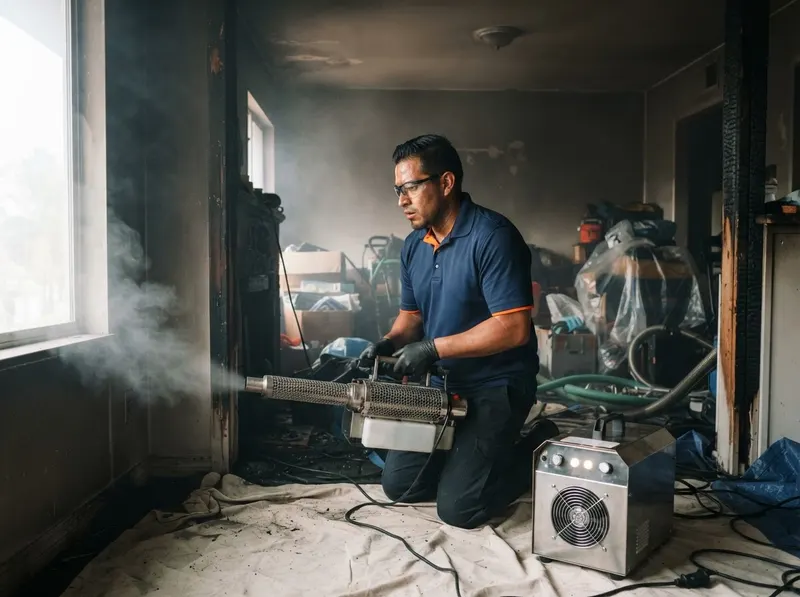
Smoke odor following a residential or commercial fire does not remain suspended in the air; heat drives volatile organic compounds, sulfur dioxide, and nitrogen oxides deep into the open pores of framing lumber, concrete slabs, and drywall assemblies. In high-heat blazes typical of canyon environments like Pacific Palisades, Brentwood, or Woodland Hills, rapid thermal expansion opens structural wood pores, which then contract upon cooling and lock in combustion gases. Standard aerosol masking agents leave these odor pockets intact, resulting in recurring smoke smells during hot afternoon cycles. Proper mitigation requires pairing thermal fogging, which pairs heat-vaporized neutralizing agents sized between 0.5 and 2 microns to penetrate the identical microscopic paths taken by the smoke, with continuous hydroxyl generation to break chemical bonds without degrading delicate interior finishes.
Hydroxyl generators replicate atmospheric ultraviolet processing through multi-wavelength UV optic chambers, producing reactive hydroxyl radicals that oxidize smoke volatile compounds into carbon dioxide and water molecules. Unlike ozone treatments that require complete structural evacuation and deteriorate rubber seals, vinyl wiring, and artwork, hydroxyl technology operates safely in occupied structures, which allows structural framing to undergo remediation while property owners retain on-site access. For dense hillside structures along Mount Washington, Highland Park, or Silver Lake, where older framing lumber holds persistent protein smoke residues from localized kitchen grease fires, targeted hot thermal fogging delivers the rapid neutralization required before reconstruction begins. Conversely, in expansive, low-pitch framing found across Encino, Studio City, Los Feliz, or Porter Ranch, industrial hydroxyl units running for 72 to 120 hours run concurrently with secondary moisture extraction to address both synthetic smoke odors and suppression water evaporation. The trade-off between the two technologies centers on access and exposure speed: thermal fogging demands brief structural clearance during deployment to fog full enclosed spaces rapidly, while hydroxyl filtration requires extended dwell times but permits concurrent interior repair work.
1. Forensic assessment: Technicians map the fire origin, classify soot boundaries (protein, wet smoke, or high-temp dry soot), and seal the treatment zone using 6-mil polyethylene containment barriers.
2. Source containment: Loose soot particles are vacuumed using HEPA filtration systems certified to 0.3 microns, preventing thermal fogs from binding with surface carbon residues.
3. Thermal vaporization: A controlled thermal generator heats an oil- or water-based counteractant, dispersing micro-droplets directly into open wall cavities, crawlspaces, and attic structural members.
4. Hydroxyl circulation: High-volume hydroxyl processors and axial air movers run continuously for 48 to 96 hours to systematically dismantle residual airborne VOCs without leaving synthetic fragrance profiles.
5. Post-clearance testing: Air quality sensors measure VOC levels and particulate matter to verify complete chemical neutralization prior to final structural reconstruction.
Every job gets a firm, written price after a free on-site visit.
Tell us about your thermal fogging & hydroxyl odor elimination job in los angeles and we'll send a clear, written quote, usually the same day.
 Top Fire Damage Restoration